As chargers gain processing power and fleets generate data, machine learning offers a new route to charge decisions that classical models derive from physics: learning the current stage that maximises efficiency (the ANFIS-controlled multi-stage constant-current schemes reported for NiMH/NiCd), recognising the end-of-charge pattern from voltage and temperature traces, and correcting model residuals in SOC and thermal estimation. This final estimation-group paper surveys what data-driven charging actually does well in NiMH, the training data and validation discipline it demands, and why production-safe designs keep a physics floor and hardwired limits beneath any learned policy - so the flexibility of learning never becomes an unbounded charge current.
Three insertion points are productive. First, profile optimisation: learning the current-stage transitions that maximise charge efficiency or minimise heat/time, exemplified by adaptive neuro-fuzzy (ANFIS) multi-stage constant-current controllers validated in simulation, which tune stage currents from the evolving voltage-temperature response. Second, estimation: neural or Gaussian-process correction of ECM/Kalman SOC and thermal predictions, capturing residual mismatch a fixed model leaves. Third, classification: recognising full charge, fault or mismatch from trace features as a parallel channel to -delta-V/dT/dt.
Each uses learning to refine a structured decision rather than replacing the charge architecture; the state machine and hard limits of the termination group remain, with learned logic adjusting parameters inside bounded ranges.

Reported NiMH/NiCd intelligent-charging work couples a boost PFC front end with a multi-stage constant-current output whose stage currents are selected by an adaptive neuro-fuzzy inference system trained on charge behaviour, and validates the scheme in MATLAB against fixed-current charging. The appeal is that the fuzzy/neural structure expresses expert rules - 'if voltage is rising steeply and temperature is calm, hold current; if the slope flattens, step down' - while learning their thresholds from data, combining interpretability with adaptation.
This is a pragmatic template: rather than an end-to-end neural network that outputs an arbitrary current, a structured controller learns the parameters of an already-safe descending-current skeleton, so even an untrained or failed learner degrades to a conservative conventional profile.
Supervised charge models need labelled ground truth: reference SOC from calibrated coulomb counting anchored at endpoints, reference full-charge instants from instrumented pressure/temperature, and heat from thermocouples - spanning the full grid of current, temperature, age and cell lot the product will meet. NiMH's lot-to-lot and age variation means a model trained only on fresh, room-temperature cells fails on aged and cold ones; dataset coverage, not algorithm sophistication, is usually the binding constraint.
Features should be physically meaningful and current-referenced - filtered dV/dt, dT/dt, resistance from pulses, cumulative charge, rest relaxations - rather than raw noisy traces, which both reduces the data needed and makes learned behaviour auditable.
A learned charge policy must be validated first against held-out data, then in hardware-in-the-loop fault injection, then in constrained chamber trials with hardwired over-temperature, over-voltage and timer limits that the learner cannot override. Because a model can propose an out-of-distribution current when faced with novel conditions, production designs clamp learned outputs within physics-derived bounds and fall back to the classical controller on uncertainty, sensor fault or disagreement between channels.
This 'advisory learning inside a hard envelope' is the same defence-in-depth philosophy as the termination criteria themselves: the learned layer optimises the nominal case; the physics floor guarantees the worst case.
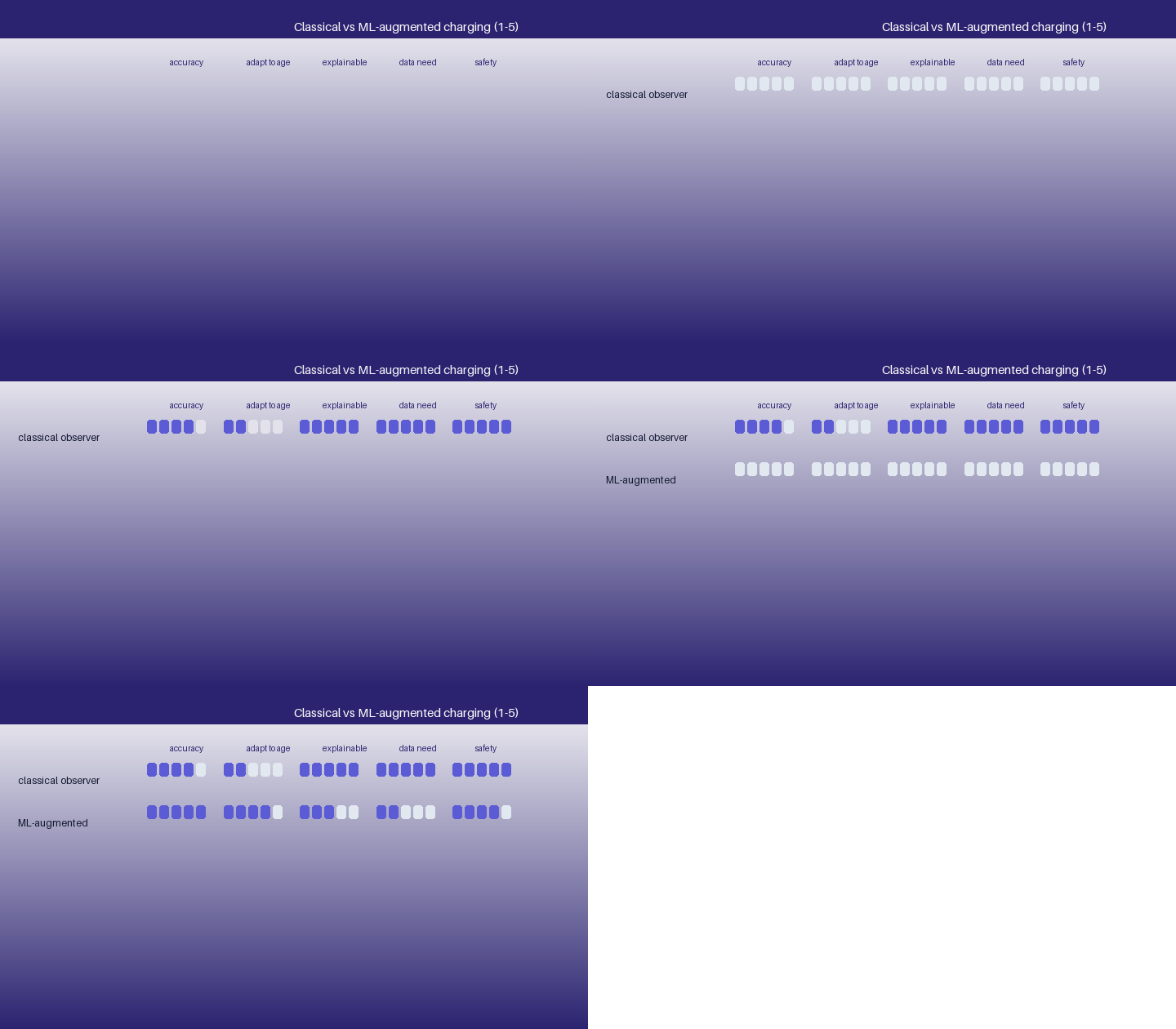
A Kalman filter on a good ECM already achieves roughly plus-or-minus 3 percent SOC from large initial error in reported NiMH work, is explainable and needs no large dataset; ML earns its place where the physics model is structurally inadequate - strongly non-linear ageing, fleet-wide parameter drift, recognising subtle fault patterns - and where enough varied data exists. Thermal-modelling reviews likewise position ML as a residual corrector to a physics core rather than a stand-alone predictor, preserving safe extrapolation.
The first figure contrasts a classical observer with a learning-augmented controller; the second sequences the safe training-to-deployment pipeline, from labelled data to bounded deployment under hard limits.
Define the decision and its allowed output bounds first; build the structured skeleton and hard limits; collect a current-temperature-age-lot spanning dataset with reference labels; train interpretable, physically featured models; prove improvement over the classical baseline on held-out cells (not merely held-out samples of the same cells); and ship with fallback, uncertainty detection and over-the-air update governance. Weijiang can supply spanning cell samples and reference charge characterisation to build such datasets without confounding cell variation with model error.
With estimation methods established - from coulomb counting to EIS, electro-thermal models and learning - the series turns from knowing the cell to watching it wear: the next group examines how charge protocol itself drives NiMH ageing and degradation.
Weijiang Power designs and manufactures nickel-metal hydride cells, matched packs and charging-ready configurations for consumer, industrial, medical and mobility customers, and supports partners with charge-protocol guidance, IEC 61951-2 performance files, IEC 62133-1 safety evidence and charger co-validation. Share your cell format, charge rate, thermal envelope and cycle target and our engineers will specify a cell-and-charge combination that protects both runtime and service life. Review the range on the products page.


