A professional two-way radio is the nervous system of a warehouse, a port terminal, a construction site, an oil refinery and a hotel engineering team - and its battery is asked to do something deceptively demanding: sit at near-zero current for most of a shift, listen at a modest current for a small fraction of the time, and then deliver a sharp one-to-two-ampere pulse every time the operator keys the transmitter. Land-mobile engineering summarises this as the 5-5-90 duty cycle - roughly 5 percent transmit, 5 percent receive, 90 percent standby - and that profile, more than any single number, dictates how a radio pack must behave. This first paper dissects the electrical load of industrial radios, explains why published talk-time and standby-time figures are always duty-cycle assumptions, shows how 7.2 and 7.5 volt nickel-metal hydride replacement packs in the 600 to 2600 milliampere-hour range are sized for twelve to twenty-four hour shifts, and traces why low, stable internal resistance - rather than headline capacity alone - is what keeps transmission clean to the last hour of a long shift. It also positions NiMH honestly against the older nickel-cadmium packs it largely replaced and against modern lithium-ion radio batteries.
Land-mobile radio testing standardises battery life around a repeating duty model: the radio transmits for 5 percent of the cycle, receives with audio active for 5 percent, and sits in standby for the remaining 90 percent. That ratio reflects real dispatch traffic - short calls separated by long listening and idle intervals - and manufacturers quote talk time, receive time and standby time separately precisely because a user who talks continuously drains a pack very differently from a user who mostly listens.
The three states differ by an order of magnitude in current. Standby is a low background current keeping the receiver front-end and logic alive; receive adds the audio amplifier and display; transmit engages the RF power amplifier at its full rated output, drawing the largest current the pack ever sees. Because the transmit fraction is small, average current - and therefore shift runtime - looks modest, but the pack must still be a competent pulse source for the whole shift, not merely a large reservoir.
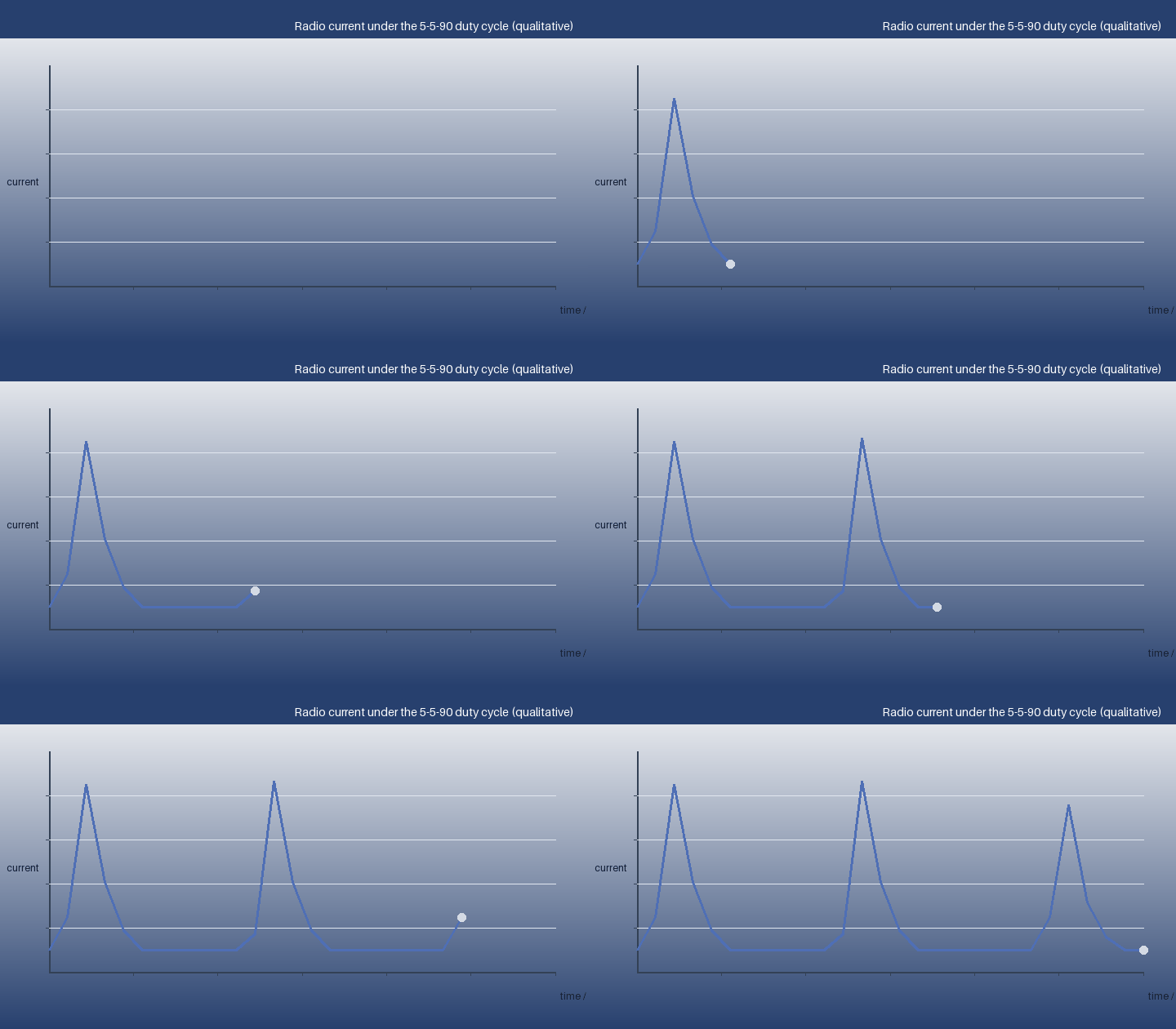
When the press-to-talk is keyed, current ramps from the receive level to a transmit peak commonly around 1 to 2 A for a 3-5 W handheld, held for the length of the call. A pack with elevated internal resistance sags under that step: supply voltage drops, the transmitter may reduce output power, audio can distort, and in the worst case the radio resets mid-call - the familiar 'dead radio' that happens precisely when the channel is busiest.
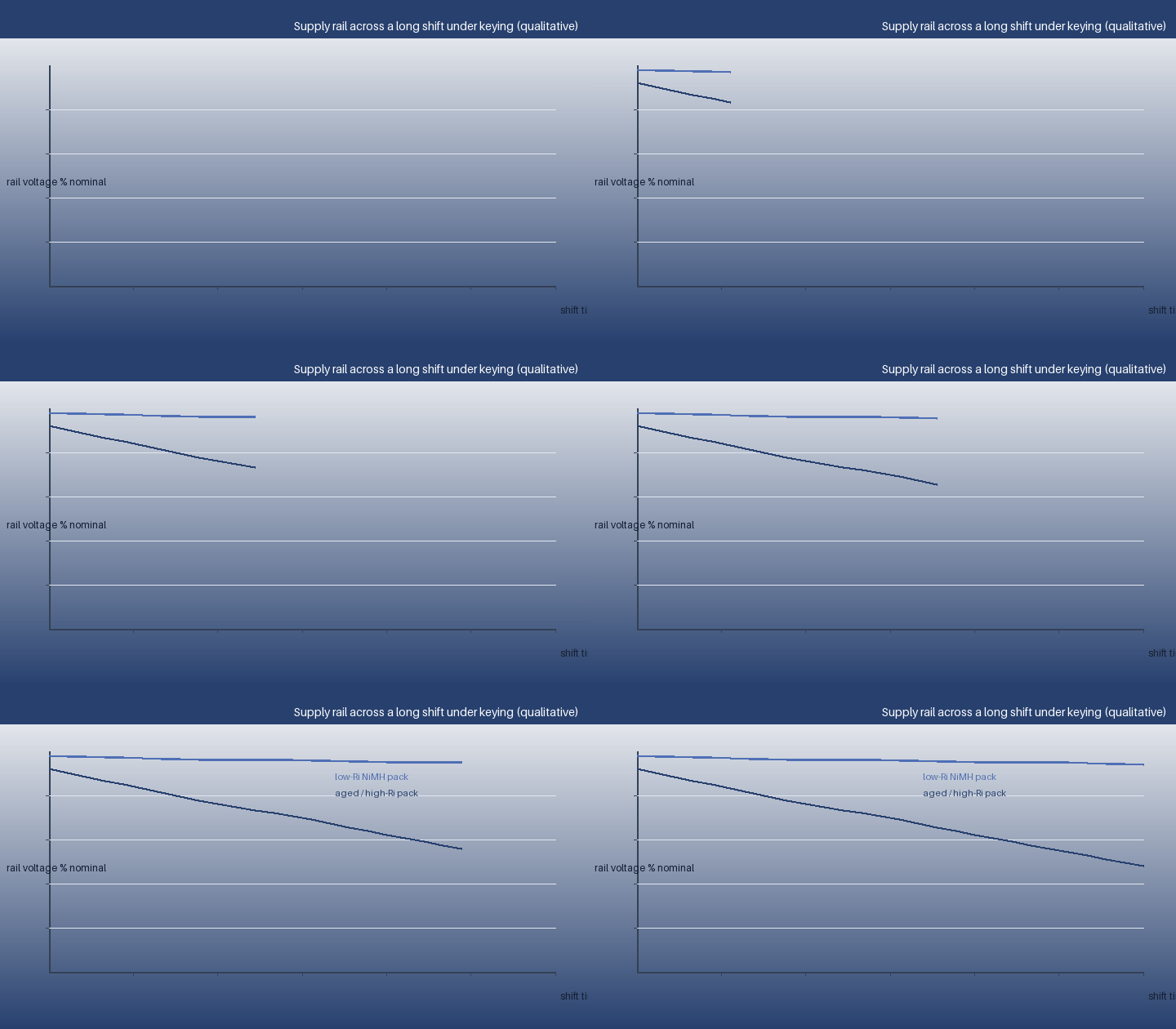
Sealed NiMH cells present internal resistance in the low tens of milliohms per cell and industrial high-rate types are built for repeated pulse discharge, so a well-matched multi-cell NiMH pack holds its rail through thousands of transmit pulses across a shift. The first animated figure draws the 5-5-90 current waveform with its transmit peaks; the second compares rail voltage through a long shift for a low-impedance NiMH pack against an aged or high-impedance one as both approach end of charge.
Handheld professional radios are typically built around six nickel-based cells in series, giving a nominal 7.2 V (or a labelled 7.5 V) pack matched to the radio's regulator and RF stage. Replacement NiMH packs for mainstream land-mobile radios are offered across roughly 600 to 2600 mAh, with common high-capacity variants around 1700, 2000 and 2600 mAh; the larger capacities extend a single charge from a single shift toward a shift and a half or back-to-back light shifts.
Sizing is a weight-versus-runtime trade-off: higher capacity means more or larger cells and a heavier pack on the operator's belt all day. The correct choice follows the real duty cycle - a security guard who mostly listens needs less than a shift supervisor who talks constantly - and the charger fleet's turnaround. Because NiMH delivers a flat discharge plateau, the radio performs consistently through most of the shift rather than gradually weakening, with end-of-charge arriving relatively abruptly and predictably.
Older industrial radios used nickel-cadmium packs, and NiMH replaced them for three well-understood reasons: substantially higher capacity in the same volume, a much reduced (though not zero) memory effect so partial discharges do not shrink usable capacity as severely, and lower environmental burden from the absence of cadmium. NiMH also has lower self-discharge than traditional NiCd when low-self-discharge (LSD) formulations are used, so a radio charged on Friday is still reasonably ready on Monday.
NiCd retains narrow niches where extreme abuse or very high charge rates dominate, but for mainstream industrial duty NiMH offers more talk time per charge and less sensitivity to shallow cycling, which suits the unpredictable partial-use pattern of dispatch radio. Modern NiMH radio packs are also designed as drop-in mechanical replacements for the original NiCd or NiMH battery, preserving the radio's latch, contacts and belt-clip geometry.
Many current radios use lithium-ion packs, which are lighter for a given capacity and hold a high voltage through discharge. The comparison must be candid: lithium-ion wins on energy density, so for the very longest shifts in the lightest package it is attractive. NiMH wins on robustness to over-discharge and rough charge regimes, tolerance of charge and discharge in the cold without the lithium plating risk that forbids cold charging, simpler pack protection, and non-lithium transport classification - and it is the natural, often form-factor-identical replacement for the enormous installed base of nickel-based radios still in service worldwide.
For organisations running mixed-age fleets, standardising on quality NiMH replacement packs keeps legacy radios economical and avoids forced hardware refresh; for new fleets in very cold or rough environments, NiMH can still be the lower-risk choice. The selection logic is duty and fleet, not chemistry fashion.
The load-profile analysis sets the requirements: a 7.2/7.5 V series pack with enough capacity for the target shift under the operator's real transmit fraction; high-rate cells with low, lot-consistent internal resistance to hold the rail through 1-2 A transmit pulses to end of life; low self-discharge for readiness after idle days; mechanical drop-in compatibility with the radio and its charger; and a wide temperature span for outdoor and industrial sites.
The second paper turns this into a concrete pack design - cell matching, tab welding and protection, capacity versus weight, charger and multi-shift fleet strategy, and the intrinsic-safe considerations for radios used in hazardous areas. The third paper then maps the radio standards (the ETSI EN 300 086/296/113 family and the Radio Equipment Directive), ruggedness and ingress ratings, ATEX/IECEx intrinsic safety, and the IEC 61951-2, IEC 62133-2 and UN 38.3 evidence behind a professional NiMH radio pack.
Weijiang Power designs and manufactures sealed nickel-metal hydride cells and matched industrial packs for remote, off-grid and safety-related equipment, and supports OEM partners with IEC 61951-2 performance files, IEC 62133-2 safety evidence, pulse-load characterisation, wide-temperature testing and charger/pack co-validation. Tell us your duty cycle, peak current, temperature envelope, autonomy target and the standards your product must meet, and our engineers will specify a cell-and-pack combination that protects runtime, reliability and service life. Review the range on the products page.


