Paper A of this series measured the battery load profile of marine AIS and GMDSS handhelds: long quiet watches, short high-current transmit pulses, and a statutory dated primary battery that must still work after years in a locker. Paper B converted that profile into a pack design: chemistry, series cell count, capacity, cold-pulse voltage margin and cradle charging. Paper C answers the question a marine equipment manufacturer and its battery supplier cannot avoid at the end of the project: how does the device, and the battery inside it, actually get certified? This is a guide to the type-approval chain for marine handheld VHF radios, survival-craft two-way VHF appliances, AIS-SARTs and personal AIS-MOB survivor-locating devices, with the tests that fall on the battery and the sealed NiMH pack. The test severities, duty cycles and pass criteria cited below come from the standards and from representative notified-body test reports; exact values on any real certificate always follow the edition and revision listed on that certificate.
Key fact 1. Certification is a four-layer chain, not a single stamp: SOLAS Chapter III regulation 6 requires the survival-craft two-way VHF appliances on board; the IMO performance standards (MSC.149(77), MSC.246(83)) define what the appliance must do; the IEC standards (IEC 61097-12, IEC 61097-14, IEC 63269 and IEC 60945) define how it is tested; and the European Union Marine Equipment Directive 2014/90/EU, with the wheel mark, is the market-access mark for EU-flagged ships. The tenth implementing regulation, (EU) 2026/1434, entered into force on 31 August 2026 and updates the list of approved equipment and standards.
Key fact 2. IEC 60945:2002 is the general environmental and EMC test standard for marine navigation and radiocommunication equipment. It sorts equipment into three categories: protected (a, below deck), exposed (b, on deck) and portable (c). Portable handhelds carry the full set of thermal shock, drop, vibration and immersion checks; functional temperature limits run from -15 C for protected gear to -25 C for exposed gear, with cold storage down to -30 C and hot storage at +70 C.
Key fact 3. The survival-craft two-way VHF appliance is tested under IEC 61097-12:1996 consolidated with Amendment 1 (2017) and Amendment 2 (2023), including eight hours of operation at the 1:9 duty cycle (6 s transmit, 6 s receive above squelch, 48 s below) at highest rated power, and immersion at 1 m for at least five minutes. The AIS-SART follows IEC 61097-14:2010 aligned to IMO MSC.246(83); the personal AIS-MOB survivor beacon follows the newer IEC 63269:2022, and uses ITU-R M.1371 AIS messages on 161.975 MHz and 162.025 MHz.
Key fact 4. The EMC suite in IEC 60945 includes electrostatic discharge immunity at 8 kV air discharge and 6 kV contact discharge with both polarities, radiated radio-frequency electromagnetic field immunity, conducted and radiated emission limits, and fast-transient, surge and power-supply interruption tests. The radio itself is additionally tested against ETSI harmonised standards in the EU, notably EN 301 025 for fixed and mobile DSC VHF, EN 302 885 for portable VHF with integrated class D DSC, and EN 300 338-5 for class H handheld DSC.
Key fact 5. The sealed NiMH cells and packs are qualified separately under IEC 61951-2:2017+A1:2022 (performance), IEC 62133-1:2017 (safety of sealed nickel-containing cells; note the -1 part), IEC 63115-2:2021 (industrial NiMH) and IEC 61959 (mechanical operation), and ship for transport under UN 3496, with IATA Special Provision A199 confirming NiMH is not restricted as lithium battery cargo. NiMH does not need the UN 38.3 lithium test summary and never travels under UN 3480 or UN 3481, which belong to lithium-ion.
Type approval is easiest to read from the top down, because each layer only answers a different question. SOLAS is the treaty. Chapter III, regulation 6 sets the carriage requirement: passenger ships and cargo ships of 500 gross tonnage and upwards carry at least three two-way VHF radiotelephone apparatus on each side of the survival-craft provision, and cargo ships of 300 to 500 gross tonnage carry at least two; the United States mirrors this count in 47 CFR 80.1095. SOLAS does not itself contain test methods; it points at the performance standards adopted by the International Maritime Organization.
The IMO performance standards are written in functional language for the buyer and the flag state. MSC.149(77) sets the requirements for the survival-craft two-way VHF, including the eight-hour endurance at the 1:9 duty cycle, the sealed dated battery, channel availability and the immersion behaviour. MSC.246(83) sets the requirements for the AIS search-and-rescue transmitter (AIS-SART). The newer IMO resolution MSC.570(109), adopted on 6 December 2024, consolidates the general performance requirements for shipborne AIS, and the general IMO resolution A.694(17) still defines the common requirements for all shipborne radio equipment. These documents say what must be achieved, but they explicitly defer the measurement detail to the IEC.
The IEC standards are the laboratory test methods. IEC 60945 is the horizontal standard for environmental and EMC testing of marine navigation and radiocommunication equipment, and it is the first document every handheld test report opens with. IEC 61097-12, IEC 61097-14 and IEC 63269 are the product-specific performance standards for the survival VHF, the AIS-SART and the AIS-MOB respectively, and each calls IEC 60945 in for the general tests while adding its own radio and endurance tests. The RF layer is governed by the AIS technical characteristics of ITU-R M.1371, while shipborne AIS equipment (as opposed to handhelds) follows IEC 62287, and GNSS receivers follow IEC 61108. Handheld portables are not shipborne class A or class B AIS, and an approval document must not confuse the two.
The final layer is market access. In the European Union, the Marine Equipment Directive 2014/90/EU replaces the old national wheel-mark approvals with a single type-examination and conformity system: a Notified Body issues the EU-type examination certificate, the manufacturer runs a supervised production quality module, and the finished item carries the wheel mark with the Notified Body's four-digit number and the year of marking. The Commission maintains the standards and equipment list through implementing regulations; the tenth and latest, (EU) 2026/1434, entered into force on 31 August 2026. Outside the EU, the United States uses FCC authorization together with United States Coast Guard approval for GMDSS items, and the marine VHF rules for survival-craft equipment are in 47 CFR Part 80; for the AIS maritime survivor-locating devices accepted in the US market, 47 CFR 95.2987 requires a letter attesting conformity to RTCM-recommended standards.
| Equipment | IMO / regulator layer | IEC / ETSI test standards |
|---|---|---|
| Survival-craft two-way VHF appliance | SOLAS III/6; IMO MSC.149(77); US 47 CFR 80.1095 | IEC 61097-12:1996 + A1:2017 + A2:2023; IEC 60945; IPX7-aligned immersion at 1 m for at least 5 min |
| AIS-SART (search-and-rescue transmitter) | IMO MSC.246(83); ITU-R M.1371 | IEC 61097-14:2010; IEC 60945; AIS channels 161.975 / 162.025 MHz |
| AIS-MOB personal survivor beacon | National survivor-locating rules; US 47 CFR 95.2987 with RTCM letter | IEC 63269:2022; ITU-R M.1371; IEC 60945 |
| Daily handheld VHF with DSC | RED 2014/53/EU and marine radio rules | ETSI EN 301 025 (fixed / mobile class D); EN 302 885 (portable with integrated class D DSC); EN 300 338-5 (class H handheld DSC); IEC 60945 |
| Shipborne AIS (reference, not handheld) | IMO MSC.570(109); ITU-R M.1371 | IEC 62287 class A / class B; IEC 61108 (GNSS); IEC 60945 |
IEC 60945:2002 (edition 4.0, with the 2008 corrigendum) defines the categories that drive every severity in the environmental program. Category a is protected equipment installed below deck, where the air is conditioned and the housing never sees spray. Category b is exposed equipment mounted on deck, where the design must survive direct rain, solar loading and salt. Category c is portable equipment, including the handheld radio and the survival-craft appliance: it inherits the severities of the exposed class and adds handling abuse that fixed equipment never sees, notably thermal shock and drop. The temperature boundaries are fixed: protected equipment operates functionally between -15 C and +55 C, exposed equipment down to -25 C, and the storage tests reach -30 C cold and +70 C dry heat.
The tests come in a deliberate sequence. Dry heat and cold tests condition the equipment in a chamber, bring it to temperature, and then require it to function at the limits; the handheld must still receive, transmit and meet its keying duty at the end of the cold soak. The damp-heat test is cyclic, at 40 C and 95% relative humidity; the IACS E10 test specification, widely used by marine notified bodies to supplement IEC 60945, extends the cycling to a hot, humid phase at +55 C and 95% for 12 hours followed by a 6-hour phase at +20 C. Thermal shock moves the portable appliance between hot and cold chambers within a short transfer time to expose seals and battery-door gaskets. The drop test releases the portable onto a hard surface from a specified height, after which it must remain operational and watertight. Vibration sweeps the transport and engine-room frequency range on all three axes. Rain and spray tests drive water at the exposed housing for a fixed duration, and immersion verifies the sealed enclosure; a handheld rated IPX7 is additionally verified to IEC 60529 at 1 m for 30 minutes, with the water temperature within 5 K of the specimen temperature, while the survival-craft appliance carries the separate IEC 61097-12 immersion at 1 m for at least five minutes. Solar radiation checks the plastics and markings, and the salt mist test exposes metallic parts and contacts to accelerated corrosion.
| IEC 60945 test | Typical severity (portable / exposed) | What the battery must demonstrate |
|---|---|---|
| Dry heat | Storage +70 C; functional +55 C | No leakage, venting or case deformation; transmit duty still supported at +55 C |
| Damp heat, cyclic | 40 C, 95% RH; IACS E10 cycles: +55 C / 95% for 12 h, then +20 C for 6 h | No corrosion at contacts, no inter-cell tracking; capacity retained after recovery |
| Cold | Storage -30 C; functional -15 C (protected), -20 C portable / -25 C exposed | Transmit pulse above the radio cutoff at the cold end-of-life condition |
| Thermal shock, drop, vibration | Portable: rapid hot/cold transfer; hard-surface drop; three-axis sweep | Welded tabs and protection devices intact; no internal short or loose cell |
| Rain, spray, immersion | Direct spray on exposed housing; IEC 60529 IPX7 at 1 m for 30 min; 61097-12 survival immersion 1 m for at least 5 min | Compartment stays dry through the battery door; no water ingress to cells |
| Solar radiation and salt mist | Radiation exposure of housing and labels; salt-mist cycling on exposed metals | Markings legible; terminals and springs free of corrosion products |
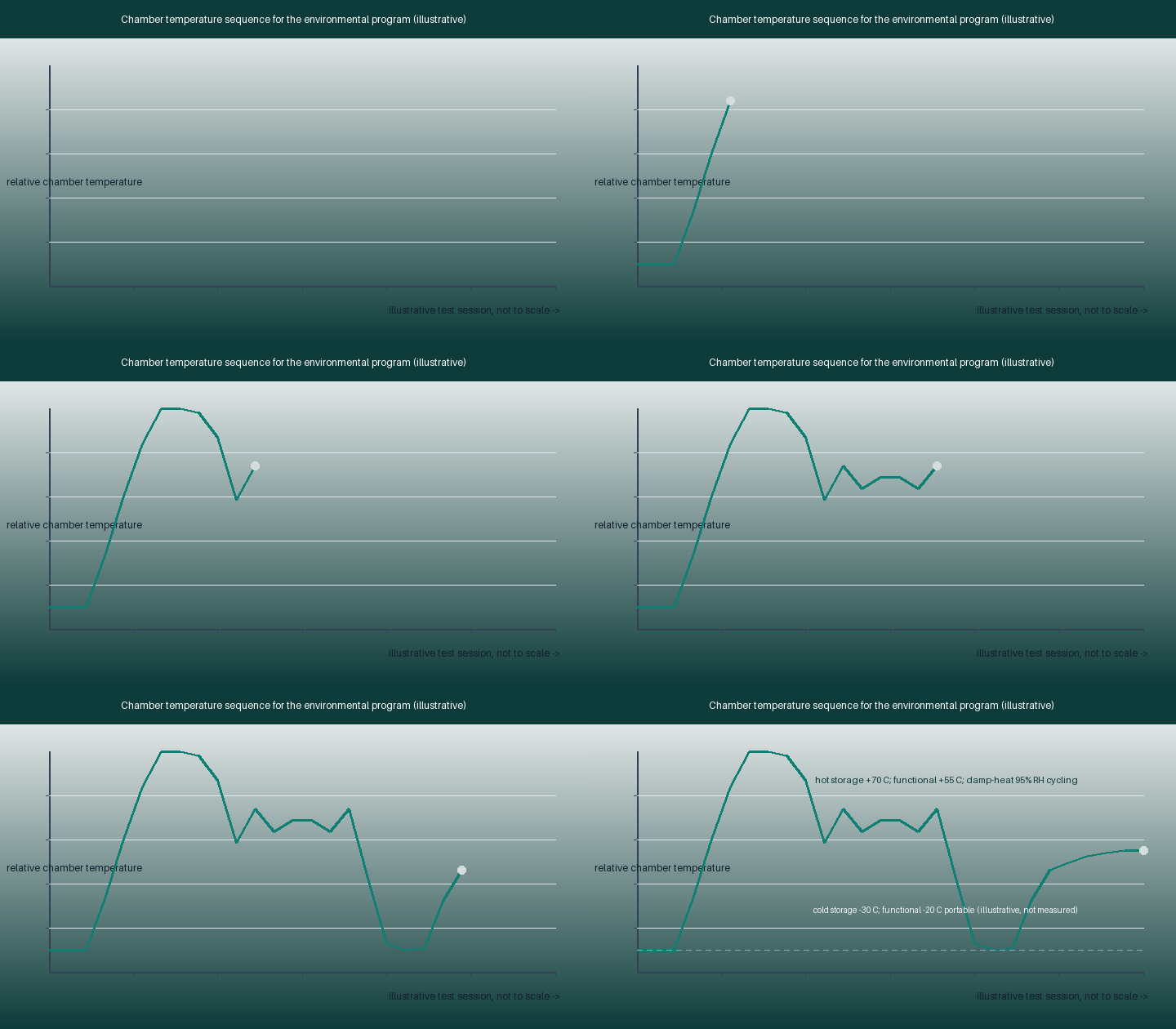
Figure 1. An illustrative environmental chamber sequence: cold storage, hot storage and repeated damp-heat cycles, followed by functional checks at the limits. The plot is qualitative; actual soak durations and transition times follow the test plan and IEC 60945 / IACS E10, not this curve.
The electromagnetic compatibility program is built on the same IEC 61000-4 series used across industrial equipment, with severities chosen for the marine environment. The most cited handheld test is electrostatic discharge immunity, performed to IEC 61000-4-2 at 8 kV air discharge and 6 kV contact discharge, applied with both polarities and repeated at multiple accessible points, including the keypad, antenna connector and battery contacts. A passing radio tolerates the discharge without permanent damage; a momentary degradation is permitted only if the function recovers by itself within the time the standard allows. On the deck of a tanker in winter, the person keying the radio is a walking static generator, so this test is far from theoretical.
The radio then sees a radiated radio-frequency electromagnetic field over the marine band and beyond, using IEC 61000-4-3 methods, plus conducted immunity injected on the power and signal lines. A cradle charger and its power supply are tested for electrical fast transients and bursts, surge immunity, voltage dips and short interruptions, and for the conducted and radiated emissions limits that keep the device from desensing the very receiver it sits next to; emissions are measured at the power terminals from 10 kHz to 30 MHz and radiated over the VHF range. The pass criterion is always functional, not cosmetic: no spurious transmissions, no loss of the stored channels or Maritime Mobile Service Identity, no display or memory corruption, and no reset of the distress mode. The battery itself is passive, but the complete battery-powered appliance is tested with its intended battery fitted, and the charging cradle is tested as an accessory.
While the appliance is being type tested, the battery supplier holds its own qualification file. For sealed portable nickel-metal hydride cells, the performance standard is IEC 61951-2:2017 consolidated with Amendment 1:2022, covering cylindrical, prismatic and button cells: dimensions, terminals, marking, charge and discharge behaviour, capacity, endurance and storage. The safety standard is IEC 62133-1:2017; the -1 part is the nickel system part, while IEC 62133-2 is lithium, and a competent file keeps the two separate. IEC 62133-1 exercises the cells against the failures that matter in a sealed handheld: continuous charging, forced discharge, external short circuit at high temperature, free fall, thermal abuse, incorrect installation, and over-discharge of the assembled battery. For industrial NiMH cells and batteries used in non-road industrial applications, IEC 63115-2:2021 is the corresponding performance and safety document, and IEC 61959 covers the mechanical operation of sealed portable secondary cells.
At pack level, the supplier must demonstrate that the cells are matched, that the interconnecting tabs are welded and strain-relieved, that the pack carries a positive thermal protection or current-interruption device, and that the insulating shrink wrap survives the vibration and thermal shock of the appliance tests. The enclosure rating is then verified separately under IEC 60529: IPX7 holds the highest point of the enclosure at least 150 mm under water (about 1 m overall for a handheld-sized item) for 30 minutes at a water temperature within 5 K of the specimen. The battery door, the hinge and the sealing gasket are the parts that actually decide whether a handheld passes immersion, and they are the parts an aftermarket copy most often changes. Finally, the appliance-level endurance test runs the battery in its final configuration: the IEC 61097-12 survival-craft protocol requires eight hours at the 1:9 duty cycle, and a responsible daily-use design proves the same margin at the cold temperature and at end of cell life, not only with fresh cells at room temperature.
Sealed NiMH is the easiest chemistry in the GMDSS cabinet to ship. The United Nations Model Regulations classify nickel-metal hydride batteries under UN 3496, and the IATA Dangerous Goods Regulations carry Special Provision A199, which confirms that NiMH batteries are not subject to the lithium battery provisions when they are properly protected against short circuits. Sea transport follows the IMDG Code with its own special provisions for the same classification. The practical consequences are real for an OEM: air-freighting replacement handheld radios and NiMH spare packs to a shipyard requires no UN Manual of Tests and Criteria section 38.3 test summary, no lithium net-quantity limits, no UN 3480 / UN 3481 labels and no lithium handling declaration, provided the packaging still isolates the terminals and prevents crushing.
The contrast with the distress battery is deliberate. The statutory sealed primary-lithium pack that ships inside the survival-craft radio, such as the 9.0 V, 3300 mAh Icom BP-234 referenced in Paper B, is lithium metal chemistry and travels under UN 3090 or UN 3091; rechargeable lithium-ion packs such as the 7.2 V BP-265 travel under UN 3480 or UN 3481, both behind a UN 38.3 qualification. A battery pack that contains no lithium cannot and should not be offered for transport under those numbers, and a commercial document that labels NiMH as "UN3480" is simply wrong. Keeping the daily NiMH pack on the UN 3496 / A199 path is one of the recurring line items an auditor checks in a marine battery shipment file.
The laboratory work is only the middle of a type-approval project. The first step is a standards map: classify the equipment (survival VHF, AIS-SART, AIS-MOB or daily handheld), fix the category of IEC 60945 exposure, and list the notified body, the radio standard and the destination market; a handheld sold into EU shipping and a handheld sold into the US market follow different conformity documents. The second step is the appliance type test, running the environmental program and the product-specific endurance and immersion protocols. The third step is the radio and EMC program at an accredited laboratory, including the ETSI harmonised standards for the EU and the FCC authorization for the US. The fourth step is the battery file: cell standards IEC 61951-2 and IEC 62133-1, IEC 63115-2 or IEC 61959 as the application requires, the IPX7 enclosure evidence, and the UN 3496 / A199 transport classification. The fifth step is the technical file and Notified Body or telecommunication certification body review; the sixth is the EU-type examination certificate with the wheel mark, the Notified Body number and year, and the production quality module that keeps the certified configuration in series manufacturing.
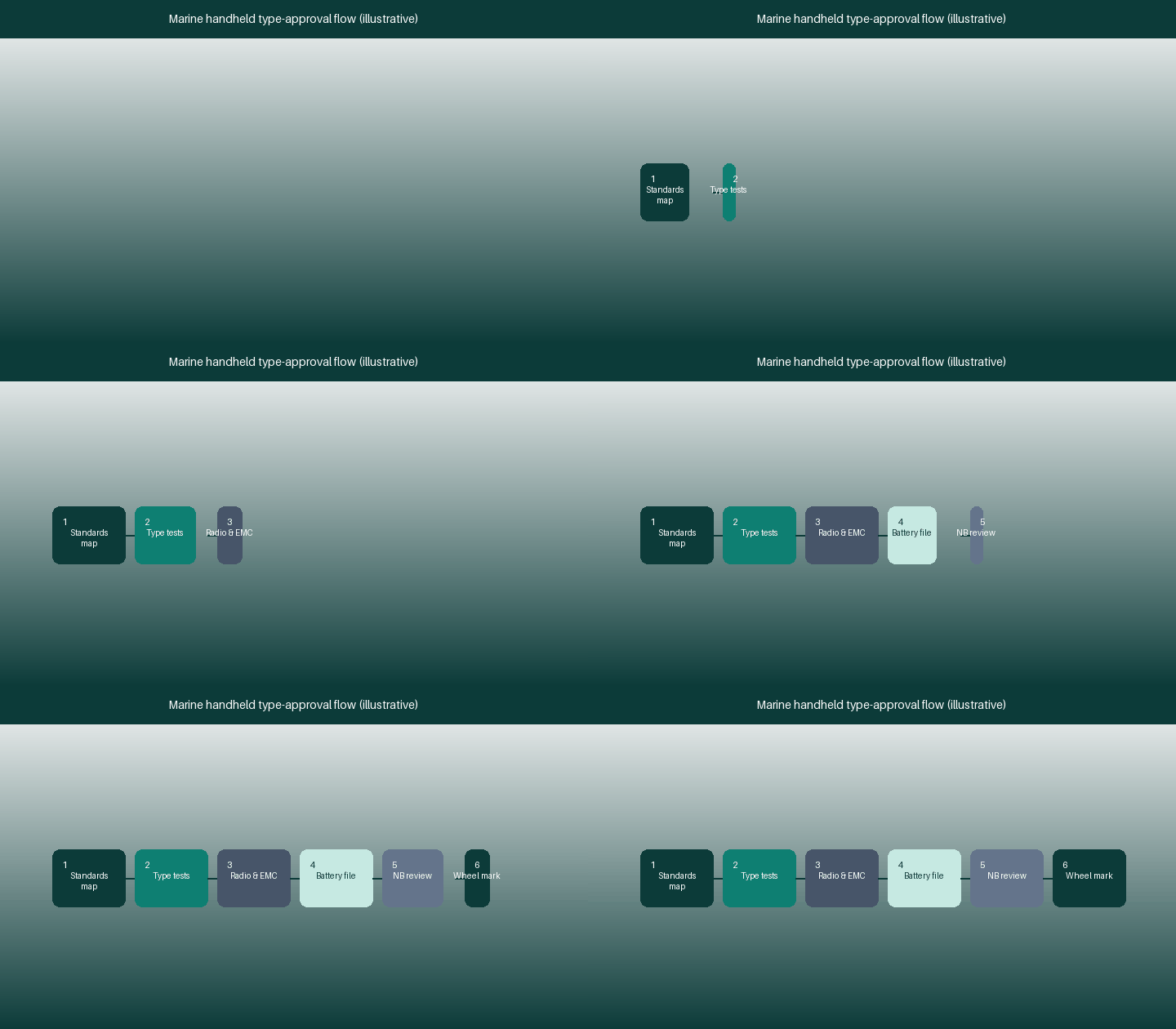
Figure 2. The six-step qualification flow for a marine handheld and its battery (illustrative project sequence; the certificate itself always lists the actual standards, editions and modules).
The detail that surprises first-time OEMs is configuration control. The type-approval certificate is attached to a tested and described configuration that includes the battery model: chemistry, cell supplier or cell specification, nominal voltage, capacity, protection device and housing. Changing the pack after the fact - substituting a different cell, deleting the PTC, or shipping a cheaper battery door with a thinner gasket - is not an ordinary procurement change; it can invalidate the certificate until the notified body assesses the difference and, where needed, repeats the affected tests. A post-certification cost reduction that is not documented through the approval process is the single most common reason a good handheld fails a flag-state or port-state inspection. Other recurring failures are easy to predict from the test list: transmit failures after damp-heat cycling, a reset under contact ESD, endurance below eight hours at the cold end-of-life condition, water tracking through the battery compartment after immersion, a missing or damaged witness seal on the dated primary battery, and a wheel mark without the notified body number or year.
Two layers apply. The appliance, battery included, is tested under IEC 61097-12 (consolidated with its 2017 and 2023 amendments) against IMO MSC.149(77), including eight hours at the 1:9 duty cycle and immersion at 1 m for at least five minutes, and it sits inside the general IEC 60945 environmental and EMC program. The sealed NiMH cells themselves are qualified under IEC 61951-2 for performance and IEC 62133-1 for safety; the dated statutory primary battery in the sealed distress appliance is primary lithium, not NiMH, and is certified as part of the appliance.
IEC 60945 is the marine equipment standard and defines immersion in the context of the equipment category; IEC 60529 is the generic enclosure standard that defines IPX7 as 1 m for 30 minutes with the water temperature within 5 K of the specimen. A handheld usually carries IPX7 as its commercial enclosure rating, while the survival-craft appliance additionally satisfies the IEC 61097-12 immersion requirement of 1 m for at least five minutes. The battery door and gasket must pass both rather than either.
The marine handheld is tested to IEC 61000-4-2 at 8 kV air discharge and 6 kV contact discharge, with both polarities at multiple points, as part of the IEC 60945 EMC program. Temporary degradation is allowed only where the standard permits self-recovery; permanent damage, a stuck keying state or loss of programmed data is a failure.
No. UN 38.3 and UN 3480 / UN 3481 belong to lithium batteries. Sealed NiMH ships under UN 3496, and IATA Special Provision A199 confirms it is not restricted as lithium battery cargo, with short-circuit protection in the packaging. The sealed primary-lithium distress battery and lithium-ion rechargeable packs do require the lithium path, including the UN 38.3 test summary.
The wheel mark is the conformity mark under the Marine Equipment Directive 2014/90/EU, placed on type-approved marine equipment after an EU-type examination by a Notified Body and a production quality module; it carries the Notified Body's four-digit number and the year. The tenth implementing regulation, (EU) 2026/1434, entered into force on 31 August 2026 and updates the equipment list and testing standards; new certifications should be checked against the current edition in force at the date of type examination.
Not without controlling the change. The battery is part of the approved configuration; changing cell chemistry, supplier, capacity, protection device, or the battery-door seal requires an engineering change assessment and, where the notified body judges the change to affect performance or safety, a certificate extension or partial retesting. This is why the cell specification, weld design and gasket drawing are frozen inside the technical file and why the approved NiMH pack must be reproduced consistently in series production.
Standards and regulatory framework: IEC 60945:2002 (Maritime navigation and radiocommunication equipment and systems - General requirements - Methods of testing and required test results), IEC 61097-12:1996 with AMD1:2017 and AMD2:2023 (survival-craft two-way VHF), IEC 61097-14:2010 (AIS-SART), IEC 63269:2022 (AIS MOB), IEC 60529 (IPX7), IEC 61951-2:2017+A1:2022, IEC 62133-1:2017, IEC 63115-2:2021 and IEC 61959 for sealed NiMH; IMO resolutions MSC.149(77), MSC.246(83), MSC.570(109) and A.694(17); SOLAS Chapter III regulation 6; ITU-R Recommendation M.1371; ETSI EN 301 025, EN 302 885 and EN 300 338-5; Marine Equipment Directive 2014/90/EU and Commission Implementing Regulation (EU) 2026/1434; IACS E10 test specification; 47 CFR 80.1095 and 47 CFR 95.2987. The chamber sequences, duty cycle calculations and project flow in this article are engineering illustrations and are labelled illustrative; the binding values for any given unit are the ones in its type-approval certificate and the standards edition cited there.
Battery and transport references: IEC 61951-2 cell performance and IEC 62133-1 safety data; the IATA guidance document for nickel-metal hydride batteries, citing Special Provision A199 for UN 3496 shipments, and the UN Recommendations on the Transport of Dangerous Goods Model Regulations; representative marine appliance evidence includes the Icom BP-234 primary-lithium survival battery and BP-265 lithium-ion pack examples used in Paper B, and the published McMurdo MT-1 IEC 60945 / GMDSS telefication test report. Temperature, humidity, ESD and immersion severities in the tables follow the published IEC 60945 text and IACS E10 excerpts; equipment-specific certificates supersede these general values.
Weijiang Power supplies sealed NiMH packs for OEM marine electronics, including daily and training handheld VHF and portable AIS applications, with the cell-level IEC 61951-2 / IEC 62133-1 documentation, welded tab and protection-device construction, and gasketing support that a type-approval project needs. Packs are built to a frozen configuration so the battery on a certificated handheld stays identical through series production, and they travel under UN 3496 with the IATA A199 path. Tell us your radio's voltage window, transmit current, duty cycle, cradle charger and target market, and we will support the environmental, EMC and transport evidence rather than discovering it at the laboratory. See the Weijiang NiMH product range for standard pack formats, or contact our OEM team with your enclosure drawing and battery specification.


